The Longest Flight That Could Ever Exist
There is a hard ceiling on how long a flight can be. Two points on Earth can be at most 20,015 km apart, half the planet's circumference, and a pair that far apart are antipodes: each one is the exact point you would reach by digging straight through the centre of the Earth from the other.
The longest flight operating today, Singapore to New York, is 15,341 km, the current holder in our ranking of the world's longest flights. That is 77% of the maximum. Nobody has ever flown anything close to the ceiling, and it is not because of aircraft range. It is because of where the water is.
➕ Add to my map | 🗺️ Preview on the map | 📥 CSV
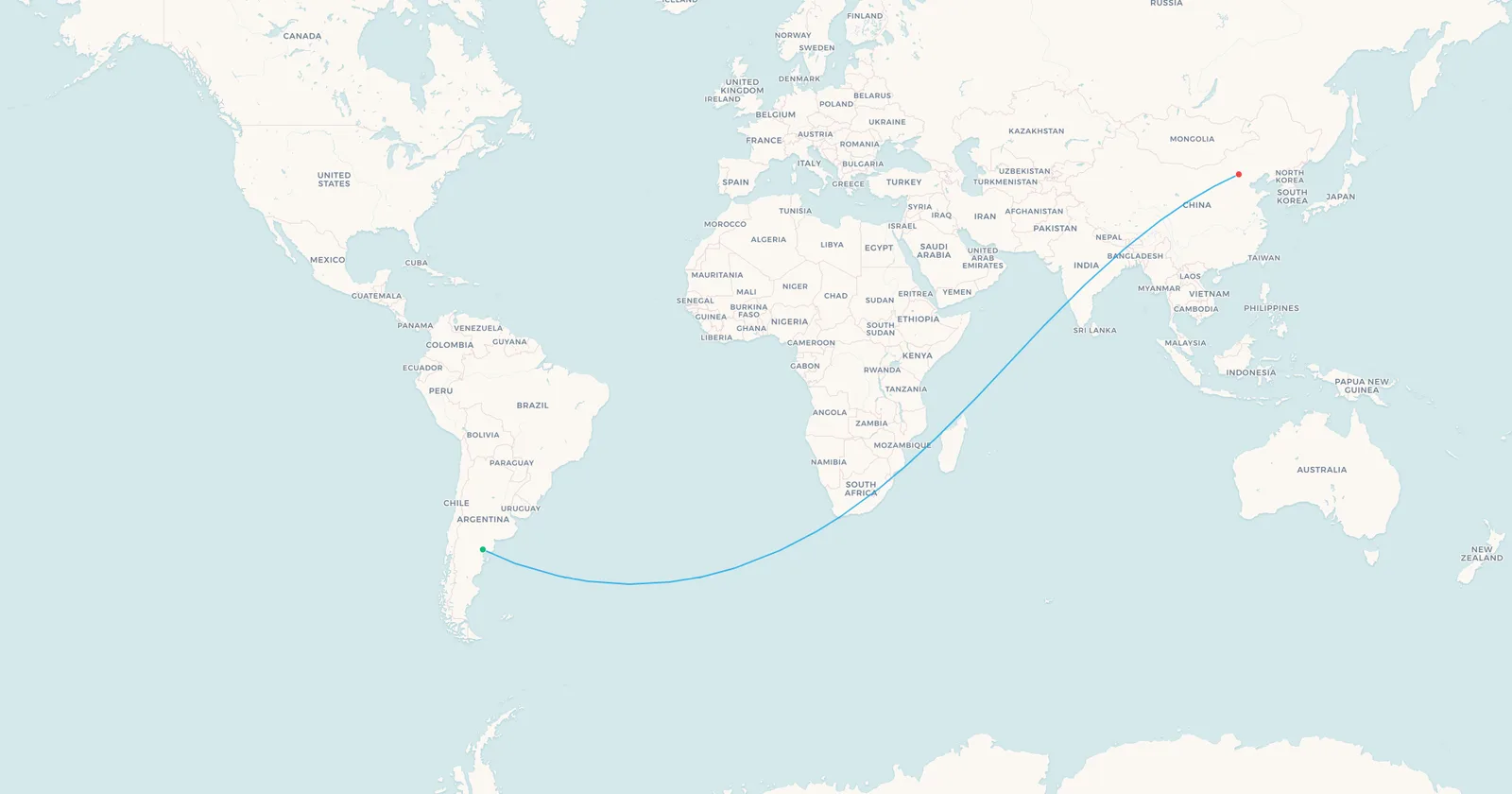
We went looking for the closest thing to a perfect antipodal flight, measuring every pair among the 6,102 airports with an IATA code in the data behind this site. The winner is above: San Antonio Oeste in Argentina and Zhangjiakou in China, 20,012 km apart. On a planet 40,000 km around, those two runways are three kilometres short of being perfectly opposite.
No airline has ever considered it. Which is the pattern for this entire article.
Why Your Antipode Is Almost Certainly Water
Roughly 71% of the Earth is ocean, but the problem is worse than that suggests, because land and water are not evenly distributed. Land tends to sit opposite water. Dig straight down from almost any major city and you surface in the middle of an ocean.
We tested it properly, using the country outlines this site already ships, and checked the antipode of thirty of the world's larger cities against them. Twenty-one of the thirty come up in open water.
| City | What is on the exact opposite side |
|---|---|
| London, Paris, Rome, Tokyo, Toronto, Istanbul | Ocean |
| New York, Los Angeles, Dubai, Delhi, Mumbai, Bangkok | Ocean |
| Sydney, Cairo, Johannesburg, Cape Town, Seoul, Mexico City | Ocean |
| Madrid | New Zealand |
| Auckland and Wellington | Spain |
| Santiago | China |
| Beijing and Hong Kong | Argentina and Bolivia |
| Singapore, Lima, Bogota | Ecuador, Thailand, Indonesia |
Sydney is the one that surprises people. The old joke about digging to China from Australia is geographically backwards: Sydney's antipode is in the North Atlantic, a long way from anywhere. It is Chile and Argentina that sit opposite China, not Australia.
Madrid to Wellington: 99% of the Maximum
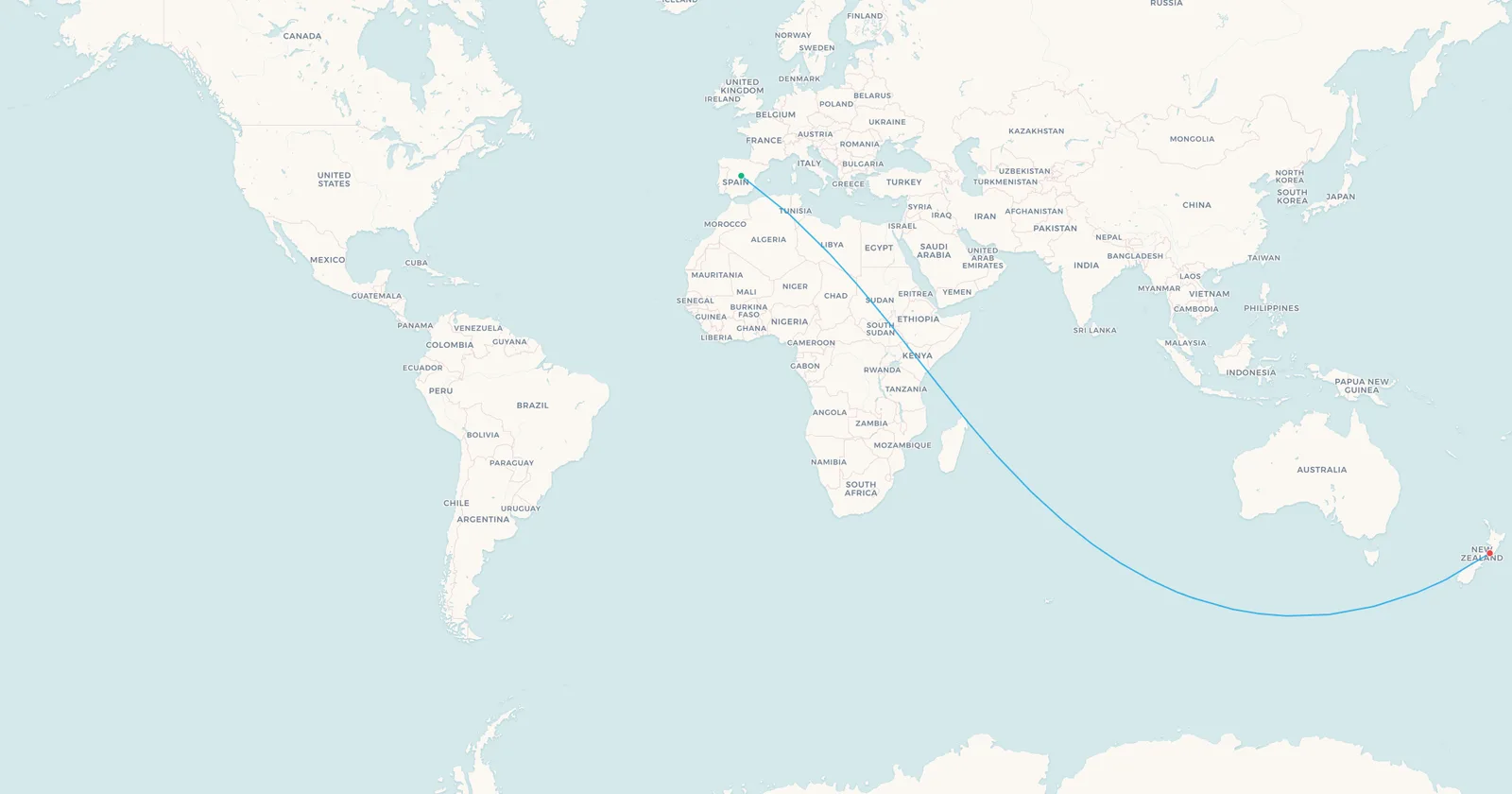
Spain and New Zealand are the largest pair of well-populated regions on Earth that sit opposite each other, which makes the Madrid to Wellington pairing the closest a serious city pair comes to a perfect antipodal flight.
➕ Add to my map | 🗺️ Preview on the map | 📥 CSV
It is 19,848 km, which is 99.2% of the geometric maximum. It is also completely impossible. The longest-ranged airliner ever built cannot cover that distance, and the aircraft now being prepared for the world's longest route falls nearly 3,000 km short of it. There is no year on any manufacturer's roadmap when Madrid to Wellington becomes a nonstop flight.
Note the shape of the line. A near-antipodal great circle can leave in almost any direction and still be the shortest path, which is why this one runs down across Africa rather than the way you would expect. When two points are opposite, every direction is equally correct.
Auckland and Seville
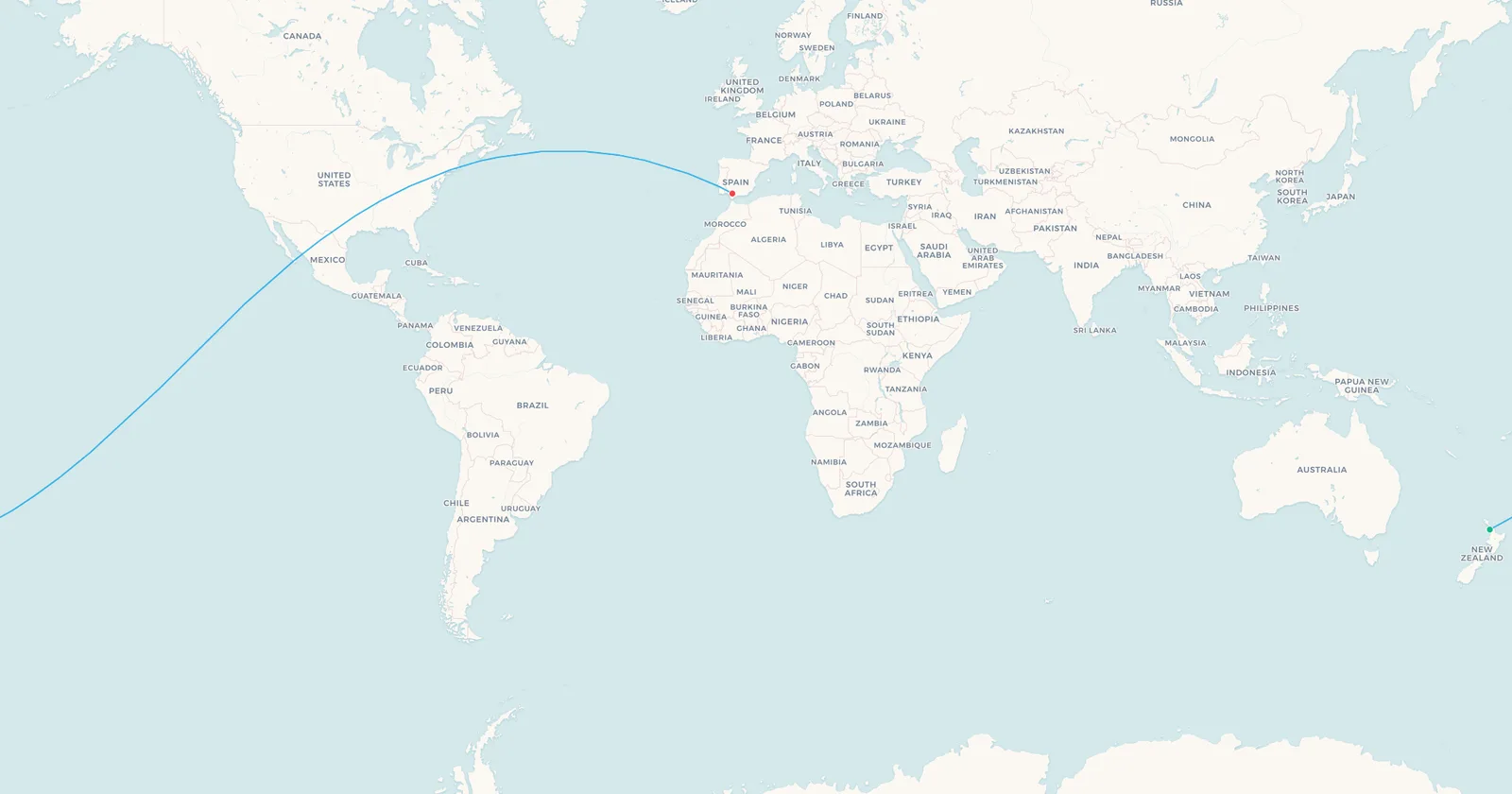
Coming the other way, Auckland's antipode lands 41 km from Seville. The two cities are 19,974 km apart, and between them lies the entire planet in whichever direction you choose.
➕ Add to my map | 🗺️ Preview on the map | 📥 CSV
This is why New Zealanders and Spaniards occasionally discover they are each other's literal opposite. It is also why the flights between them are among the most awkward journeys in commercial aviation: there is no efficient way to cross half a planet, because every route is exactly as long as every other.
Santiago and Hong Kong, the Pacific Pairings
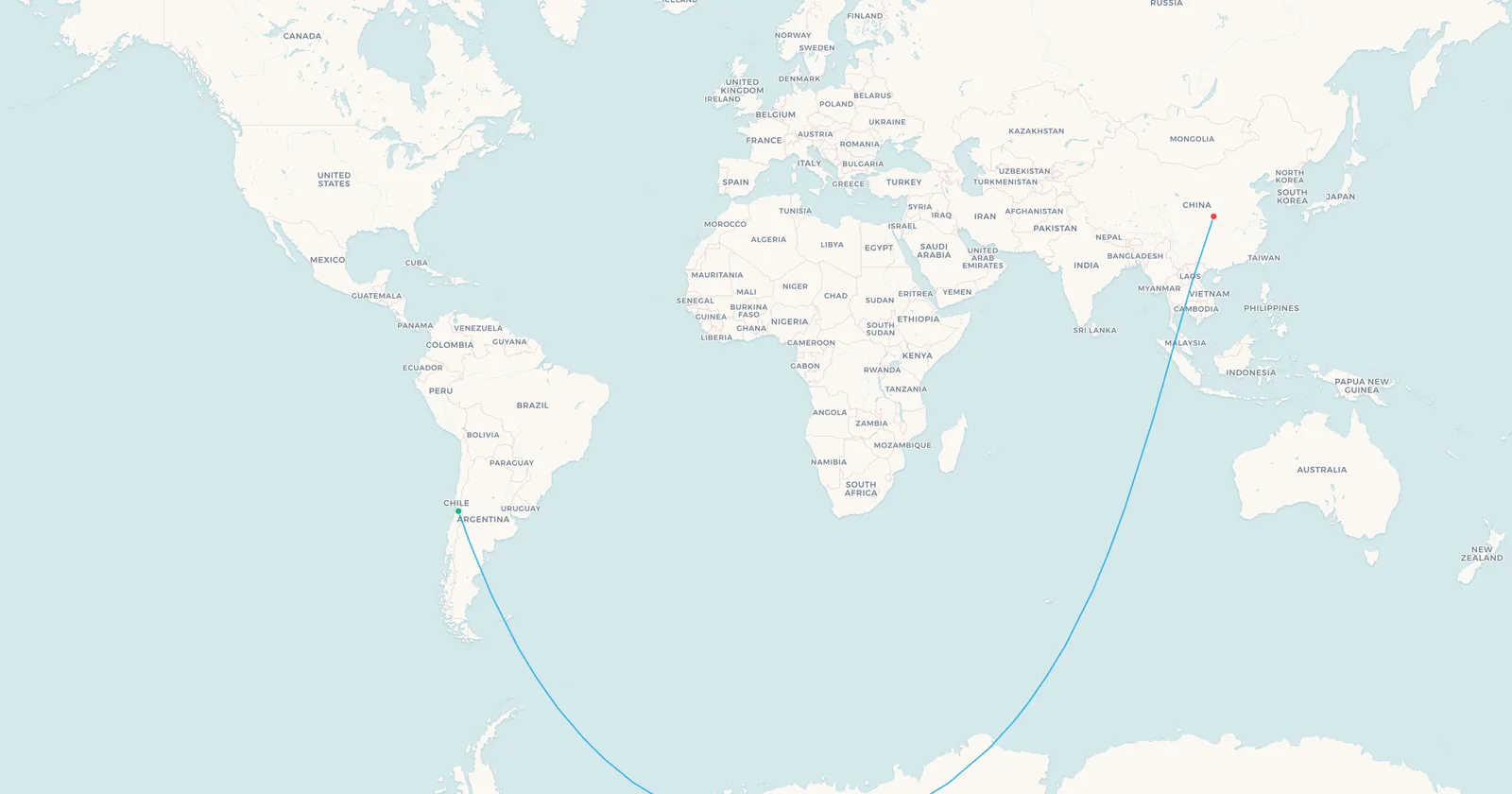
South America and East Asia are the other populated antipodal pair. Santiago's opposite point falls 81 km from Ankang in central China.
➕ Add to my map | 🗺️ Preview on the map | 📥 CSV
And Hong Kong's lands 165 km from Tarija in southern Bolivia, 19,850 km away.
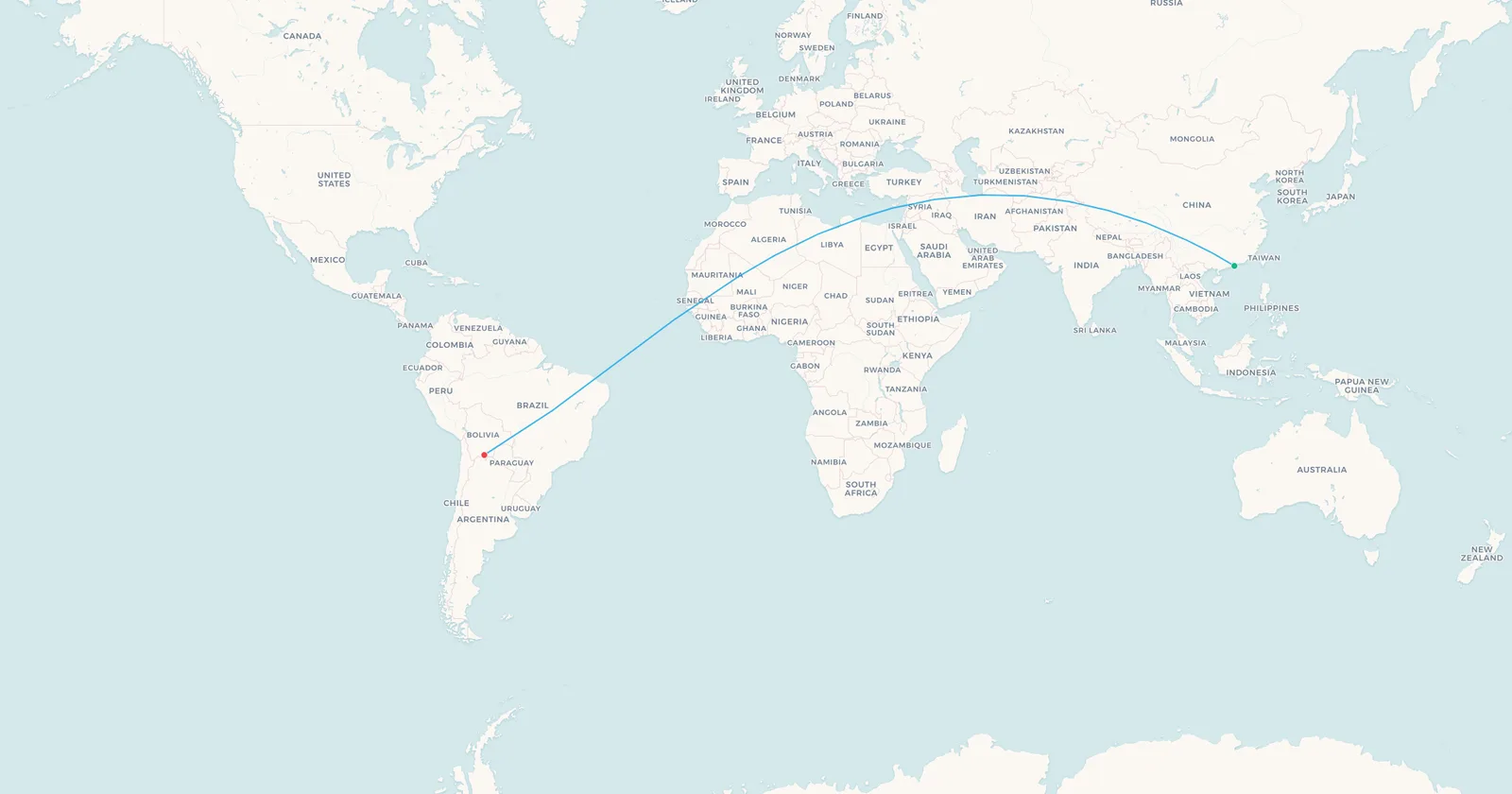
➕ Add to my map | 🗺️ Preview on the map | 📥 CSV
Search flights Hong Kong → SantiagoSearch flights HKG → SCLThese pairings explain something real about how you actually travel between South America and Asia, a problem we looked at in South America to Australia flights. When two regions are near-antipodal, there is no short way round and no natural hub in between, because the midpoint of the journey is open ocean in every direction.
How Close Can a Real Flight Get?
Three numbers frame the whole question.
| Flight | Distance | Share of the 20,015 km maximum |
|---|---|---|
| Singapore to New York, the longest flight today | 15,341 km | 77% |
| Sydney to London, from October 2027 | 17,021 km | 85% |
| Madrid to Wellington, which cannot be flown | 19,848 km | 99% |
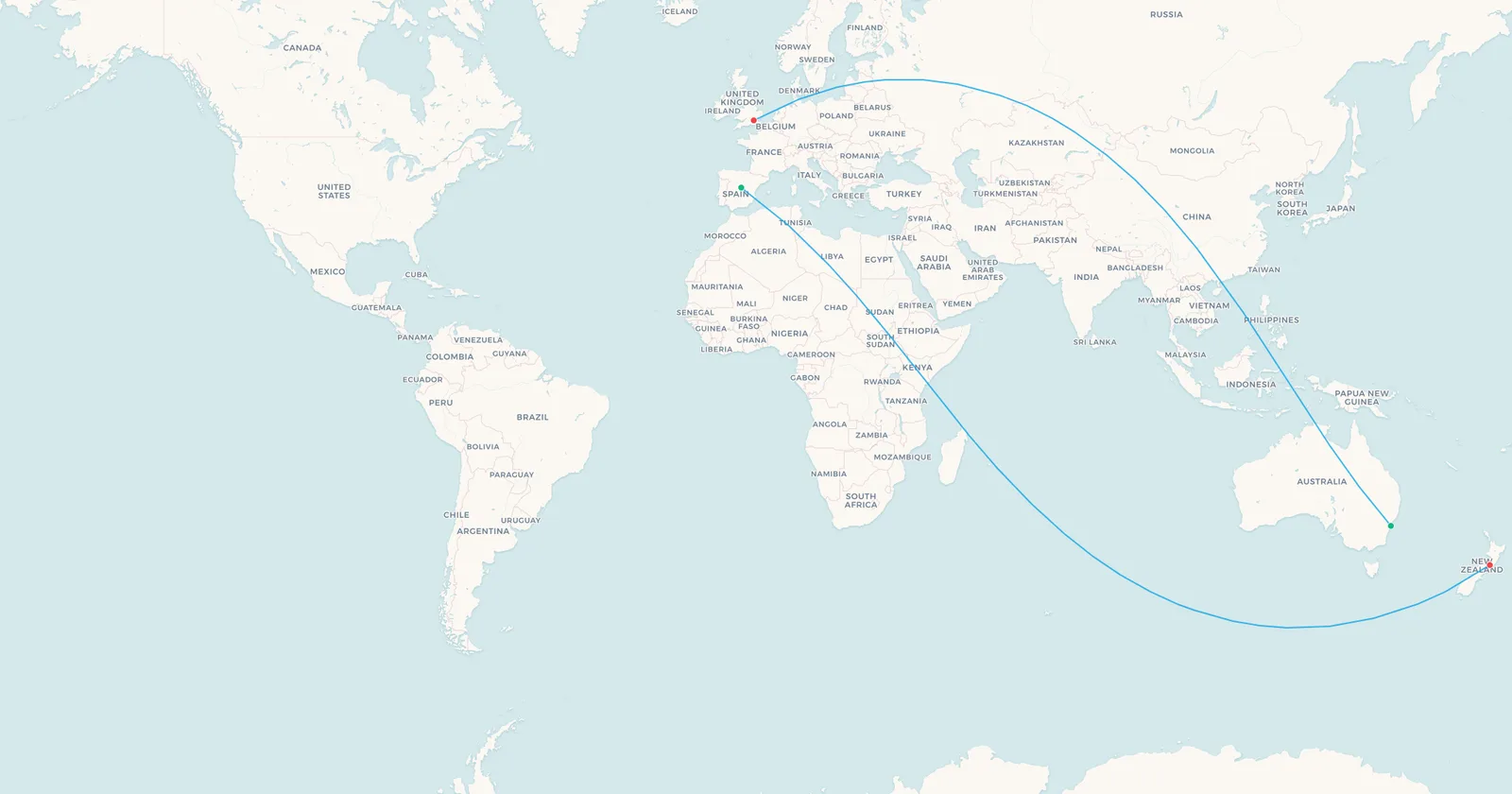
➕ Add to my map | 🗺️ Preview on the map | 📥 CSV
Qantas begins Sydney to London nonstop in October 2027, and even that record-breaking route reaches only 85% of the ceiling. The gap between the longest flight humans will fly and the longest flight geometry allows is about 3,000 km, and closing it would require an aircraft with the range to fly Madrid to Wellington, serving a market of one.
There is a further curiosity in the flight that currently holds the record. Singapore to New York passes within about 280 km of the North Pole, peaking at 87.5 degrees north. That is beyond the edge of the standard web map projection, which stops at 85 degrees, so the world's longest flight cannot be drawn completely on an ordinary map at all. Our guide to transpolar flight routes covers what flying that far north involves.
What an Antipodal Flight Would Actually Need
The ceiling is not a range problem in the way people assume. It is a demand problem wearing a range problem's clothes.
Aircraft range has climbed steadily, and the jet being prepared for Sydney to London is purpose-built for the job, with an extra fuel tank and a deliberately light cabin. That work is the subject of our guide to Qantas Project Sunrise. But every extra kilometre of range is bought with fuel weight, and fuel weight displaces the passengers who pay for the flight. Push far enough and you arrive at an aircraft that can cross half the planet carrying almost nobody.
Now add the second problem. An airline would have to want to. The populated antipodal pairs are Spain with New Zealand, and South America with East Asia. Between Madrid and Wellington there is no business market, no significant diaspora and no cargo flow that would fill a widebody every day. The route that would set the record is also the route with the least reason to exist, and that is not a coincidence: the same distribution of land and ocean that makes the pair antipodal is what leaves so few people at either end.
So the record will keep being set by routes like Sydney to London, which are long because two large economies happen to sit far apart, rather than by any route chosen for its distance.
Frequently Asked Questions
What is an antipode?
The point on the Earth's surface directly opposite another, so that a straight line between them passes through the centre of the planet. Two antipodal points are always 20,015 km apart measured across the surface, which is half the Earth's circumference.
What is the longest flight that is physically possible?
About 20,015 km, between any two antipodal points. No scheduled flight has ever come close: the longest today, Singapore to New York, is 15,341 km, or 77% of that ceiling.
Why are there no antipodal flights?
Because the antipode of almost every city is ocean. Of thirty major cities we tested, twenty-one have their opposite point in open water. The few populated antipodal pairs, chiefly Spain and New Zealand, are further apart than any airliner can fly.
What is on the opposite side of the world from Spain?
New Zealand. Madrid's antipode falls 71 km from Palmerston North, and Auckland's falls 41 km from Seville. Spain and New Zealand are the largest pair of populated antipodal regions on Earth.
Is Australia opposite China?
No, despite the saying about digging a hole to China. Sydney's antipode is in the North Atlantic. It is Chile, Argentina and Bolivia that sit opposite China.
Which two airports are the most nearly antipodal?
San Antonio Oeste in Argentina and Zhangjiakou in China, 20,012 km apart, just 3 km short of perfectly opposite.
What will be the longest flight in the world?
Qantas begins Sydney to London nonstop in October 2027, at about 17,021 km. It will take the record from Singapore to New York and still reach only 85% of the geometric maximum.
Sources
The antipodal pairs, the distances and the land-or-water test are our own calculations, made from the airport coordinates and country outlines this site runs on, so every figure can be reproduced from the CSVs on this page. Distances are measured across the surface of a sphere of radius 6,371 km.
- The longest flight today: Upgraded Points on Singapore Airlines SQ23 and SQ24 to New York.
- Sydney to London: The Points Guy and The National on Project Sunrise and its October 2027 start.
The longest journey the Earth permits is 20,015 km, and the planet has arranged itself so that almost nobody needs to make it.